

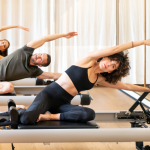
Are you looking for a great way to build core strength? A Pilates exercise program might be the perfect fit for you. Developed by Joseph Pilates, this mind-body practice is built on the idea that true strength comes from your center, or “powerhouse.” It’s designed to give you mastery over your body by focusing on developing a strong core. The benefits of Pilates go beyond just toned abs; it creates functional strength that supports your entire body in daily life.
Top Reasons Pilates Excels at Building Core Strength
The Pilates method stands out because it targets your core in a unique and comprehensive way. Unlike workouts that only focus on the surface-level abdominal muscles, Pilates engages the entire system of core muscles, including the deep stabilizers that support your spine.
This holistic approach is one of the key benefits of Pilates. By teaching you to activate and control these muscles, you build genuine core strength that translates into better posture, less pain, and improved movement. Let’s explore the specific reasons why Pilates is so effective.
1. Engages Multiple Core Muscle Groups Simultaneously
When you think of your core, do you just picture your abdominal muscles? The core is actually a complex system of muscles that includes your abdomen, back, hips, and pelvic floor. It acts as the foundation for all of your body’s movements. Pilates exercises are designed to work these different muscle groups in harmony.
Instead of isolating one muscle at a time, the movements require your entire core to work together. This coordinated effort is what builds true, functional core strength. You are training your muscles to function as a unified system, just as they do in your daily activities.
This simultaneous engagement creates a powerful and stable center. You’re not just building a “six-pack”; you’re creating a supportive structure that enhances your body’s overall stability and strength, from the inside out.
2. Focuses on Deep Stabilizing Muscles (Transverse Abdominis)
One of the secrets to Pilates’ effectiveness is its focus on the transverse abdominis. This is the deepest of your abdominal muscles, and it wraps around your torso like a natural corset, extending from your ribs to your pelvis. Its main job is to hold in your organs and provide core stability for your spine.
Weakness in the transverse abdominis is often linked to low back pain. Pilates was one of the first exercise methods to emphasize isolating and engaging this specific muscle. You’ll often hear instructors use the cue to “draw your belly button toward your spine,” which is a technique for core muscle activation.
By learning to activate this deep muscle, you build a stronger core from its very foundation. This enhances spinal support and control, which is essential for preventing injury and moving with greater efficiency.
3. Enhances Posture and Alignment Through Controlled Movements
Do you find yourself slouching at your desk or experiencing nagging back pain? The Pilates method can help you achieve better posture and alignment. The exercises are built on principles of control and precision, teaching you to move with intention and awareness.
When you have a strong core, the muscles that support your spine are better equipped to hold your body in proper alignment. Studies have shown that Pilates exercises are effective at improving postural alignment, which can make a big difference in how you stand, sit, and move throughout your day.
A stronger, more aligned posture doesn’t just look better; it also helps distribute weight more evenly across your spine and joints. This can reduce unnecessary strain and alleviate the kind of chronic discomfort and back pain that many people experience.
4. Reduces Risk of Low Back Pain by Strengthening Support Muscles
If you struggle with low back pain, strengthening your core with Pilates could be a game-changer. Many studies have found that Pilates is an effective way to treat this common issue. The pain is often caused by weak and unstable muscles around the trunk, abdomen, and pelvis.
Pilates directly addresses this by building core strength in these exact areas. By reinforcing your body’s natural support system, you can significantly reduce the strain on your lower back muscles. This focus on stability is a key component of injury prevention.
A stronger core helps you maintain better form during all kinds of activities, which can prevent:
- Overuse injuries
- Muscle strains
- Back spasms
5. Improves Balance and Coordination with Functional Movements
Your core is essentially your body’s center of gravity. When you build core strength, you naturally improve your stability, which leads to better balance and coordination. Pilates is filled with functional movements that challenge your body to stay stable while your limbs are in motion.
This improved balance isn’t just for the studio. It translates directly into your daily life, making it easier to perform everyday tasks like reaching for something on a high shelf or playing with your kids on the floor. You’ll move with more confidence and grace.
This increased body awareness and control also boosts athletic performance and reduces your risk of falling, especially as you get older. Beginners often notice they feel less clumsy and more centered after just a few weeks of practice.
6. Adapts to All Fitness Levels with Scalable Exercises
One of the best things about Pilates is that anyone can do it. The exercises are easily adaptable to all fitness levels, so it doesn’t matter if you’re a complete beginner or a seasoned athlete. Each movement can be modified to match your individual needs and abilities.
You can start with the basics on a mat and gradually progress to more advanced movements. For an added challenge or assistance, you can also use a Pilates Reformer, which uses springs and pulleys to provide resistance.
There are many ways to get started, allowing you to choose what works best for you:
- Join a Mat Pilates or Reformer class at a local studio.
- Find a Pilates class at your gym.
- Try at-home workouts with online videos.
7. Promotes Mind-Body Connection for Better Core Engagement
The Pilates method is more than just a physical workout; it’s a practice in “Contrology,” or gaining mastery of your mind over your body. This requires concentration, control, and precision in every movement, which fosters a powerful mind-body connection.
As you practice, you develop a heightened sense of body awareness. You learn to feel which muscles are working and how to activate them correctly. This is especially important for core engagement, as it teaches you to turn on your deep stabilizing muscles with intention.
This newfound awareness doesn’t disappear when you roll up your mat. You’ll start to notice your core engagement during daily activities, whether you’re lifting groceries or sitting at your computer. This constant, subconscious support is what leads to lasting strength and stability.
8. Encourages Consistent Practice for Sustainable Results
The key to achieving a strong core and seeing lasting strength gains is consistent practice. Because Pilates is low-impact and easily modified, it’s an enjoyable form of exercise that people are more likely to stick with over the long term.
Unlike high-intensity workouts that can leave you feeling drained, a Pilates session often leaves you feeling energized and centered. This positive reinforcement makes it easier to build a regular routine and stay motivated.
The benefits of Pilates build over time with consistency. A regular practice can lead to:
- Sustainable improvements in core strength and stability.
- Enhanced athletic performance and reduced injury risk.
- Long-term relief from issues like back pain and poor posture.
How Pilates Targets and Activates the Core
So, how does a Pilates exercise achieve such effective core muscle activation? The magic lies in its unique combination of specific poses, controlled movements, and coordinated breathing techniques. Both static (held) and dynamic (moving) exercises are used to challenge your core in different ways.
This approach encourages the deep muscles of your core to contract in a coordinated fashion, building strength and endurance. Two of the most important elements in this process are the specific way you breathe and the slow, deliberate nature of the movements.
Breathing Techniques That Deepen Core Activation
In the Pilates method, breathing is not an afterthought—it’s fundamental to the exercise. Joseph Pilates insisted on it, and modern science confirms why it’s so important. Your diaphragm, the primary muscle of respiration, works in synergy with your deep core muscles.
When you coordinate your breath with your movements, you enhance core muscle activation. Typically, you are cued to exhale on the effort of a movement. This action naturally helps you engage your deep abdominal and pelvic floor muscles, like gently hugging your waist from the inside.
This intentional use of breath transforms a simple movement into a powerful core-strengthening exercise. It is a form of strength training that:
- Deepens the connection to your core.
- Ensures the correct muscles are firing.
- Improves overall stability and control.
The Role of Slow, Controlled Movement in Muscle Engagement
Unlike many workouts that focus on speed and high repetitions, the Pilates method emphasizes slow, controlled, and precise movements. This deliberate pace forces your muscles to stay engaged throughout the entire range of motion, eliminating the use of momentum.
This technique is particularly effective for building deep muscle strength and endurance. One key aspect is the focus on eccentric control, which is the ability to control a muscle as it lengthens. For example, when you slowly roll down in the Roll Up exercise, your abs are working hard to control the descent.
This type of training builds functional strength and impressive core stability. It develops long, lean muscles that are both strong and flexible, contributing to better posture and a reduced risk of injury.
Key Core Muscles Worked in Pilates
Pilates provides a complete workout for your core because it targets all the major muscles of the midsection, not just the ones you see in the mirror. Truly functional strength requires a balanced approach that addresses the front, back, and sides of your torso.
The muscles of the core that you’ll strengthen include the deep transverse abdominis, the superficial rectus abdominis, the obliques on your sides, the stabilizing lower back muscles, and the foundational pelvic floor. Let’s look at each of these groups more closely.
Transverse Abdominis (Deep Stabilizer)
The transverse abdominis is your body’s deepest core stabilizer. Think of it as an internal corset that wraps around your midsection, providing support and stability to your spine and pelvis. Its primary role is to hold everything in, creating a solid foundation for movement.
Because it’s so deep, this muscle is often overlooked in traditional workouts. However, Pilates places a strong emphasis on its activation. The common cue to “hollow” the abdomen by pulling the navel toward the spine is specifically designed to engage the transverse abdominis.
Strengthening this muscle is crucial for building genuine core strength and is directly linked to reducing low back pain. Consistent core muscle activation in Pilates ensures this foundational muscle becomes strong and responsive.
Rectus Abdominis (“Six-Pack” Muscle)
The rectus abdominis is the most well-known of the abdominal muscles—it’s the one that can form the “six-pack.” This long muscle runs down the front of your body and is primarily responsible for forward flexion, like when you do a crunch or sit up.
While traditional ab workouts often focus exclusively on this muscle, Pilates integrates it into movements that also challenge your other core muscles. This creates balanced strength gains and ensures the rectus abdominis works as part of a team.
Exercises like the Roll Up and The Hundred are excellent for strengthening the rectus abdominis. Research has even shown that Pilates is effective at improving the endurance of this muscle and helping to repair abdominal separation (diastasis recti) after pregnancy.
Internal and External Obliques
Your internal and external obliques are the muscles that run along the sides of your torso. They are essential for any movements that involve twisting, turning, or bending sideways. Strengthening them is crucial for rotational power and stability.
Many Pilates exercises use your own body weight to challenge the obliques. Movements like the Criss-Cross require you to rotate your trunk, directly targeting these muscles and building functional strength.
Studies have shown that experienced Pilates practitioners have a greater ability to engage their internal obliques, indicating that the practice is highly effective for training these important muscles. A strong set of obliques contributes to a powerful core and a defined waistline.
Multifidus and Lower Back Muscles
A healthy core isn’t just about strong abs; the lower back muscles are just as important. These muscles, including the deep multifidus and the erector spinae, run along your spine and are vital for support, mobility, and posture.
The multifidus is a key stabilizer that supports each vertebra, and keeping it strong is a critical part of injury prevention. Pilates exercises strengthen these posterior muscles, creating a balanced “corset” of strength that supports your entire torso.
By reinforcing these support structures, Pilates helps alleviate and prevent back pain. Instead of just working the front of your body, you build 360-degree strength that protects your spine during all of your daily activities.
Pelvic Floor Muscles
The pelvic floor muscles form the “floor” or foundation of your core. This sling of muscles supports your pelvic organs and plays a crucial role in stability, posture, and bladder control. It’s an often-neglected part of the core, but Pilates brings it to the forefront.
The focus on deep, controlled movements and coordinated breathing in every Pilates exercise naturally engages and strengthens the pelvic floor. This increased strength and body awareness can be especially beneficial for postpartum women or anyone experiencing pelvic floor dysfunction.
A strong pelvic floor is integral to overall core strength. By learning to activate these muscles correctly, you complete the “container” of your core, creating a truly stable and powerful center.
Most Effective Pilates Exercises For Core Strength
Ready to put this knowledge into practice? Certain classic Pilates exercises are famous for their ability to build incredible core strength. These movements are central to both Mat Pilates and Pilates Reformer workouts, using your own body weight to challenge and activate your core muscles.
These exercises are designed to test your stability, control, and endurance. As you get stronger, you can advance the movements, but even the basic versions are highly effective. Here are a few of the most powerful Pilates exercises for your core.
The Hundred
The Hundred is a signature Mat Pilates exercise that serves as a fantastic warmup and core conditioner. It challenges your abdominal endurance and teaches you to stabilize your core while your limbs are moving, all while coordinating your breathing techniques.
To perform it, you lie on your back, lift your head and shoulders, extend your legs, and pump your arms vigorously while taking five short breaths in and five short breaths out. This continuous movement and breathwork quickly build heat and deep core muscle activation.
This exercise is a powerhouse for building a strong, stable center. Its main benefits include:
- Warming up the entire body.
- Strengthening the deep abdominal muscles.
- Improving breathing capacity and control.
Roll Up
The Roll Up is a classic Pilates exercise that is amazing for building abdominal strength and improving spinal flexibility. It involves slowly rolling your torso up from a lying position to a seated position, reaching toward your feet, and then controlling the movement as you roll back down.
This exercise is a true test of core control. It requires you to use your core muscles to articulate your spine one vertebra at a time, rather than using momentum. The slow, controlled descent is a form of strength training that builds eccentric strength in your abdominals.
Using only your body weight, the Roll Up challenges your core in a way that crunches can’t match. It promotes both strength and length in your muscles, creating a lean and powerful midsection.
Single Leg Stretch
The Single Leg Stretch is a staple of Mat Pilates core training and is part of the “series of five” abdominal exercises. In this movement, you lie on your back with your head and shoulders curled up, hugging one knee into your chest while extending the other leg out.
You then switch legs in a continuous, controlled motion. The challenge is to keep your torso perfectly still while your legs are moving. This forces your deep abdominal muscles to work hard to stabilize your pelvis and spine.
This Pilates exercise is excellent for building abdominal endurance and control. It teaches you to maintain a strong center while your limbs move independently, a crucial skill for both athletic activities and everyday life.
Plank Variations
The plank is a well-known exercise for building core strength, and Pilates incorporates several effective variations. These static holds challenge your muscle strength and endurance, requiring your entire core to work together to maintain a straight line from your head to your heels.
A Forearm Side Plank, for example, is excellent for targeting your obliques. You can increase the challenge by lifting your top leg or modify it by bending your knees. Other Pilates exercises, like the Bird Dog, act as a dynamic plank, challenging your balance and stability.
Plank variations are a fantastic way to build full-body strength using just your body weight. Some excellent options include:
- Forearm Plank
- Side Plank
- Bird Dog (Quadruped)